Case Study / Club & Lounge
Coverage and boundary noise control for an open-air garden restaurant facing a residential street.
Project summary
- Challenge
- An open space that has to carry background music, acoustic sets and DJs while limiting the sound that reaches the homes nearby.
- Solution
- Speakers aimed at the tables, a vertical sub stack, presets for each mode and automixing for the live sets.
- Result
- Each way of using the space has its own preset, and the sound energy is aimed at the areas where guests are served.
From First Survey to Handover
01 / Diagnosis
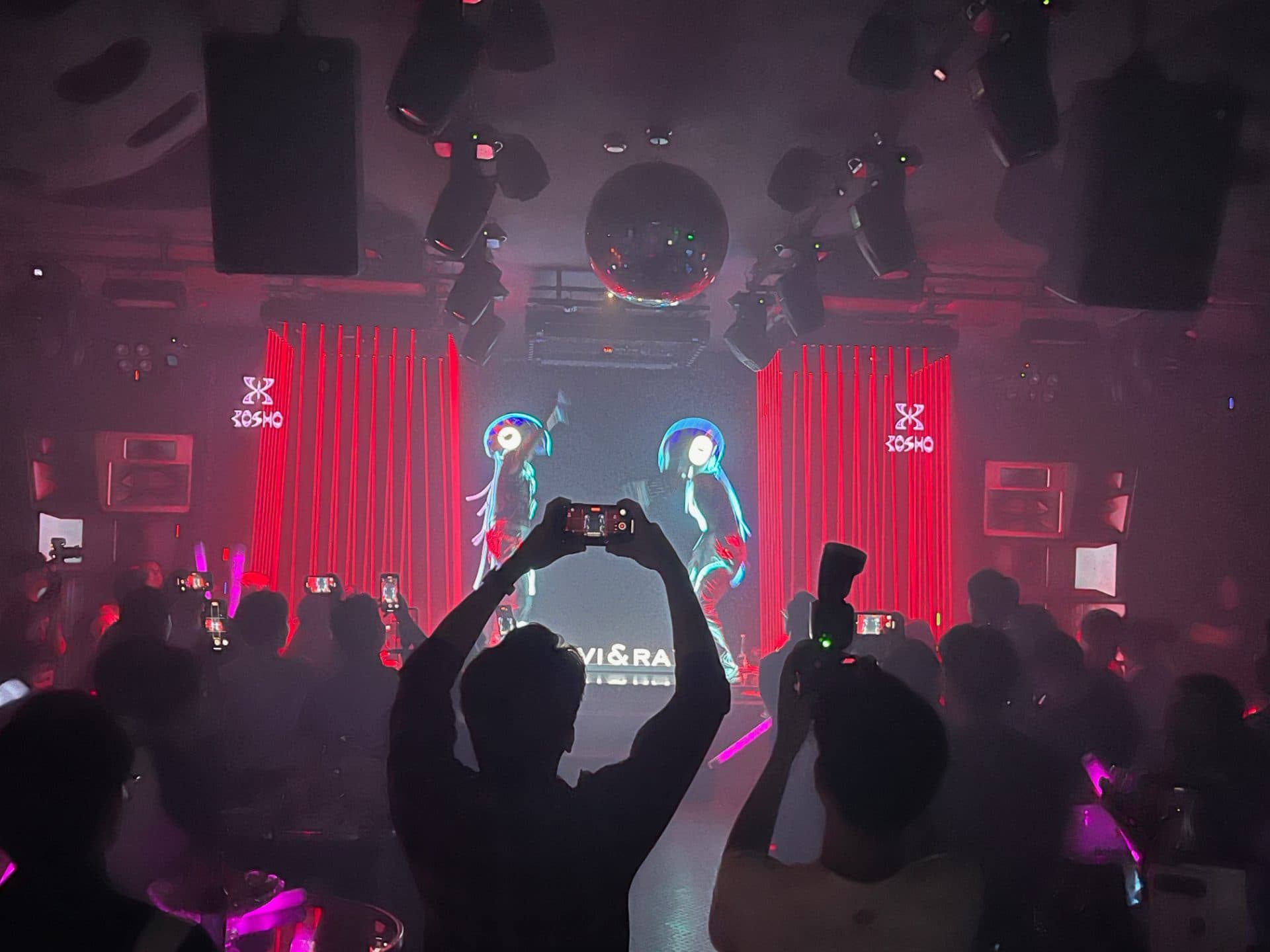
A completely new build. After Tony Lab Audio had fixed the phase cancellation and burned-out speakers at Kosho Club, the owner, Mr. Hiep, trusted us to advise on and design the whole sound solution for Chóe Food Garden from the drawings onwards. The garden architecture is open, with a high roof and no enclosing walls or ceiling to hold the sound — it fades very quickly with distance and easily sounds thin. Across the street is a residential area, so the firm requirement was to deliver the bass and clarity the DJ and acoustic sets need at the tables without letting the sound hit or bounce into the homes opposite, while the equipment budget for a music-led F&B venue had to be kept tightly under control.
02 / Engineering decision
We arranged six 12-inch full-range speakers as two V-shaped clusters, three per side, tilted towards the tables to reduce direct sound towards the neighbouring homes. Two dual 2×15-inch subwoofers form a vertical stack; its directivity depends on array dimensions and frequency, so boundary spill must be checked on site. The Behringer X32 Producer and YME Audiotechnik DSP provide crossover, time alignment and Peak/RMS limiting. Gain-sharing AutoMix supports the acoustic sets, with Background/Acoustic/DJ scenes and training for the band and staff.
03 / Verification and value
The handover survey recorded SPL uniformity within ±2.5 dB across the 350m² listening area and a reduction of more than 12dB at the residential boundary. The earlier table-to-table difference was a design prediction, not a like-for-like before measurement. Boundary compliance still depends on the absolute level, measurement conditions and applicable limits. Coverage is focused on the dining area, while spill is checked outside it.
“After the Kosho project, I was completely comfortable handing Chóe’s sound over to Tony from the moment the frame went up. The sound covers every table evenly — clear, but never harsh. Because Tony set the speaker angles precisely, we play DJ music every night and the neighbours don’t complain. Best of all, the staff switch the modes for the band themselves, smoothly, with no extra cost for a technician.”
Before and After
| Metric | Before | After |
|---|---|---|
| Sound pressure (SPL) uniformity | More than 10dB difference between tables | Even within ±2.5 dB across the whole 350m² |
| Sound leaking to the homes nearby | Boundary noise risk identified at the design stage | More than 12dB lower at the residential boundary |
| upper midrange coverage | Spreading into the space outside | Coverage aimed at the table area; spill checked outside it |
| System protection (Limiter) | Not configured | Peak/RMS Limiters locked on the YME DSP |
Frequently asked questions
Is RT60 measured in an open-air restaurant the same way as in a closed room?
No. An open space has no enclosing reflective surfaces to build a diffuse sound field, so RT60 does not apply — the measurements focus instead on the noise reaching the boundary (Boundary Noise) and on SPL uniformity between the table areas.
How do you stop the DJ and acoustic sets from disturbing the homes across the street?
Aim the main speakers towards the tables to reduce direct sound towards the homes, then measure spill at the boundary. A vertical sub stack changes vertical directivity according to its dimensions and frequency; it does not automatically cancel horizontal spill. Reflections and low-frequency propagation still need checking.
How does Automixing on the X32 mixer work for an acoustic band?
Gain-sharing AutoMix adjusts the gain of participating microphone channels. The Background/Acoustic/DJ scenes recall routing and level settings, while the operator still manages the musical balance and unexpected changes during a performance.