Case Study / Residential
A system designed for a 12m² room shared by music listening and vocal practice, with a tidy interior.
Project summary
- Challenge
- A small room with a low ceiling, glass and concrete walls prone to resonance and a higher risk of feedback with condenser microphones.
- Solution
- Speakers, sub and microphones matched to the room; FIR for phase, crossover, EQ and time alignment; a tidy interior layout kept.
- Result
- A shared system for listening and vocal practice, tuned at the listening position, with the roles of the DSP and the acoustic treatment clearly separated.
From First Survey to Handover
01 / Diagnosis
After hearing the smooth, true-to-life sound at My Phuoc Chapel, delivered by Tony Lab Audio, Ms. Mai decided to invest in a completely new YME Audiotechnik system for her family apartment in Phu My Hung, District 7. The room had two uses: relaxing Hi-Fi listening, which demands separation and a clear stereo image; and vocal and music practice with the choir — Ms. Mai is the parish’s solo singer, and the listening room is also where she rehearses live vocals and practises singing with piano accompaniment. The challenge was the space: a small 12m² room (4m long, 3m wide, 2.4m high) whose low ceiling causes very strong bass resonance in the corners; the concrete walls and flat glass stretch the reverberation time, blurring the vocals and raising the risk of feedback with sensitive microphones.
02 / Engineering decision
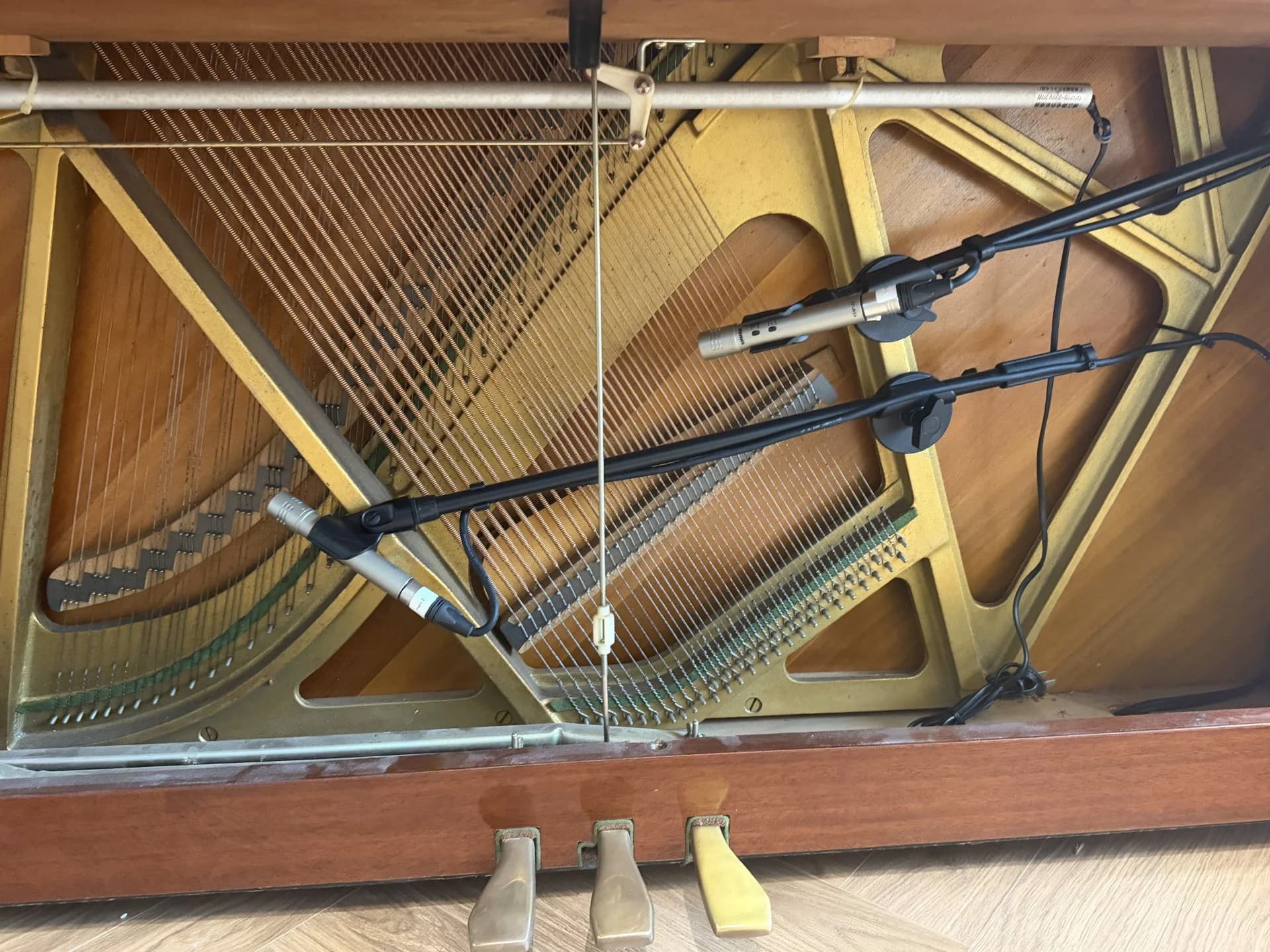
We installed a pair of YME CS 9P full-range Main speakers with precisely controlled coverage, together with a YME CS 212 subwoofer placed in the centre against the floor to use the Room Gain well and keep bass cancellation spots to a minimum, running on a YME DPA 2.0 amplifier with built-in DFM (Germany) DSP. We used custom FIR processing alongside crossover and time alignment to match the subwoofer and CS 9P speakers at the listening seat, and on the DSP applied three layers of tuning: a flexible Crossover, Parametric EQ to tame the resonances caused by the low ceiling and flat walls, and Time Alignment & Delay set precisely to the central listening seat. For recording, we supplied a Neumann KMS 105 vocal microphone for solo work and a Shure Beta 58A for group practice, plus a pair of Shure KSM 137 instrument microphones placed in stereo for the piano, using balanced XLR microphone connections; Neutrik NL4FXX speakON connectors are used on the loudspeaker lines; Peak/RMS Limiters protect the system when singing live at high levels.
03 / Verification and value
The frequency response is flat within ±2.5 dB from 45Hz to 18kHz at the listening seat. The treble is fine and airy, the vocals clear, with reduced harshness at the listening seat. The DSP/FIR system improved the sound thoroughly without bulky acoustic panels, keeping the apartment’s elegant interior as it was — a single matched solution that serves both relaxing Hi-Fi listening and high-quality live singing and vocal practice.
“In the late afternoon I love sitting on the sofa listening to music. The more I listen, the more I like it — the sound is smooth and gentle but detailed. When I practise with the choir, my voice comes through lightly and the microphone picks it up well, with no muffled or boomy sound.”
The Project in Pictures
Before and After
| Metric | Before | After |
|---|---|---|
| Bass resonance (40–150Hz) | Forecast peaks of +8 to +12dB at 60Hz and 110Hz | Placement, level and EQ checked at the listening seat |
| Frequency Response | Not yet tuned, forecast to vary widely at the listening position | ±2.5 dB from 45Hz to 18kHz at the listening seat |
| Sub/main crossover alignment | Phase offset forecast before installation | Sub/main time and phase alignment checked around the crossover |
| Experience in use | Not yet installed — only drawings and an engineering forecast | Settings for music listening and live vocal practice |
Frequently asked questions
Can one system serve both Hi-Fi listening and live singing or vocal practice?
One system can serve both uses if its output, response, microphone routing and gain structure suit the room. The PA or Hi-Fi label alone does not establish suitability or protection against overload.
Should a 12m² listening room with a low ceiling have a subwoofer?
A subwoofer can extend bass and relieve the mains, but the decision depends on the target response, listening level, placement and room modes. In a 12m² room, check the result at the listening seats and set crossover, level and phase accordingly.
Does a high-end condenser microphone (such as the Neumann KMS 105) cause feedback in a family room?
Feedback depends on the acoustic loop gain, microphone pattern and position, speaker coverage and operating level, rather than the condenser label alone. Set gain structure and EQ at the intended use level and keep the microphone out of strong loudspeaker coverage.