Case Study / Club & Lounge
Zoned sound for a 500m² bistro with a stage, a bar, a mezzanine and a VIP area.
Project summary
- Challenge
- The live band distorted; the volume differed between areas; the open frontage had to limit the sound leaking to the homes opposite.
- Solution
- Point-source speakers allocated zone by zone, a planned low end, DSP tuning and reuse of the equipment that still fits.
- Result
- The stage, bar, mezzanine and VIP each have their own coverage, so the venue can be run flexibly at different times of day.
From First Survey to Handover
01 / Diagnosis
In early 2022 we surveyed Palms Bistro on a recommendation from the DOM Club project. The old system had deteriorated, coping only with light background music during the day and distorting completely when the band played live each evening. The frontage is fully open and faces a residential street directly — a loud live band easily draws noise complaints. The high ceiling and several separate areas (Main Zone, Bar, mezzanine, VIP rooms) left the SPL badly unbalanced: initial measurements showed a difference of more than 12dB between the area by the stage and the mezzanine.
02 / Engineering decision
We kept the Behringer X32 Producer mixer and the band’s existing JBL monitors, and focused the budget on what directly decides the sound quality. Fourteen 10-inch point-source speakers were each given their own tilt angle by zone: 8 in the Main Zone angled in towards the centre tables to reduce direct sound towards the homes opposite (2 of them covering the bar), 3 filling in the mezzanine, and the remaining 3 shared between the large and small VIP rooms behind the bar. Four 18-inch subs form a broadside sub array along the front edge of the stage, with spacing and alignment checked for the guest areas and nearby boundaries. On the Linea Research DSP we set Time Alignment, Crossover and protective Limiters, then loaded a custom FIR Filter to optimise the frequency response and phase — keeping the upper midrange smooth and the vocals clear without harshness at high SPL. Scenes and hands-on training support the band’s routine setup; live mixing still needs an operator.
03 / Verification and value
Measured results: SPL uniformity across the 500m² is now within ±2.5 dB, down from more than 12dB at the start. Sound leaking to the homes opposite dropped by 8–10dB. Custom FIR processing shapes response and phase through the vocal range, checked alongside crossover alignment at the listening positions.
“Tony Lab’s new system neatly solved the two hardest problems: in the daytime the background music is very smooth, and at night the live band plays with real force while guests sitting near the speakers can still talk comfortably. The neighbours across the street no longer complain about the noise.”
The Project in Pictures
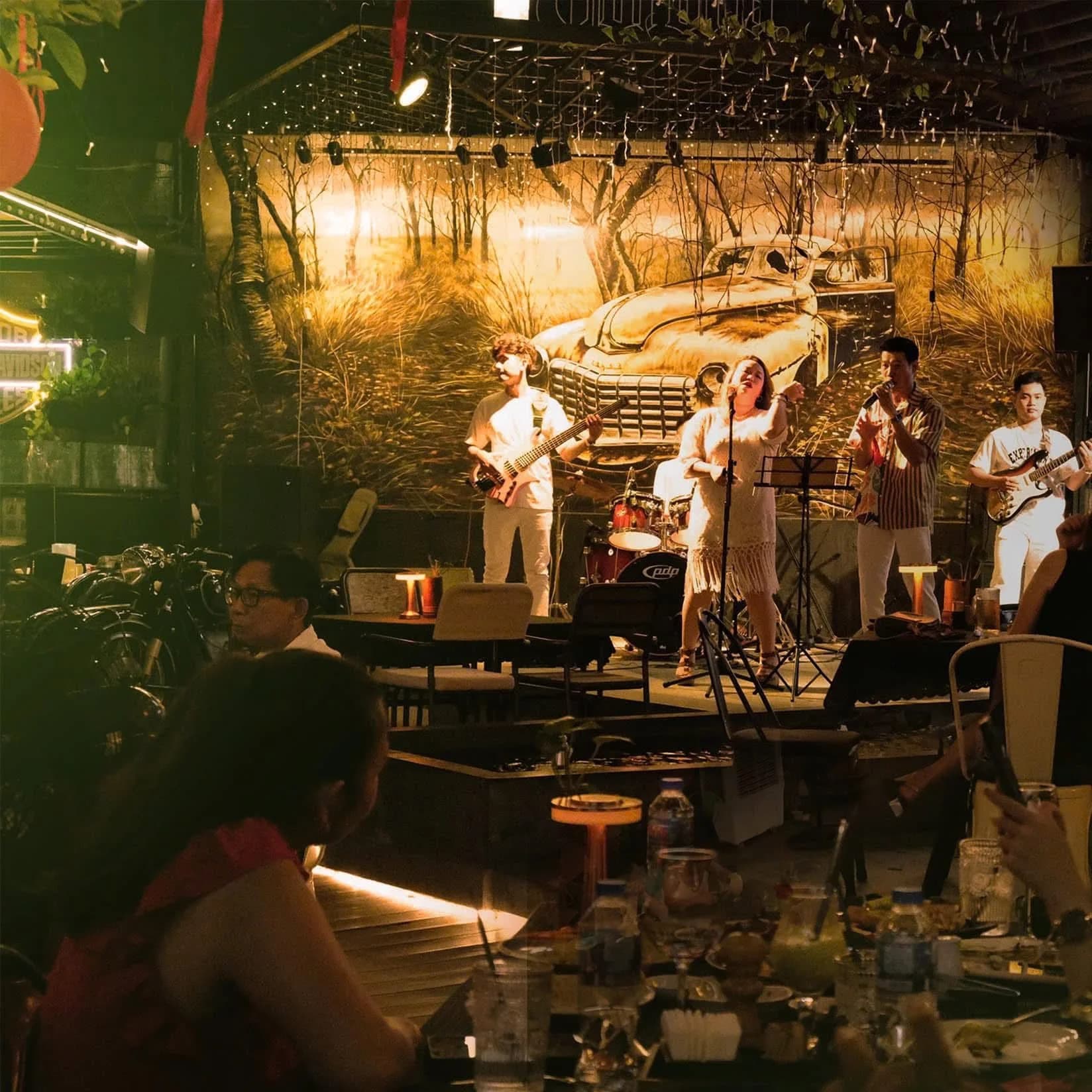


01 / 04 — A close-up of the band performing in the evening at Palms Bistro, with warm stage lighting and vintage-bike decor behind.
Before and After
| Metric | Before | After |
|---|---|---|
| SPL balance across the venue | More than 12dB difference between the area by the stage and the mezzanine | Tilt angles set zone by zone, SPL uniformity within ±2.5 dB across 500m² |
| Noise towards the residential area | Open frontage facing homes; the live band easily exceeded night-time noise limits | Speakers angled inwards; sound leaking to the homes reduced by 8–10dB |
| Zoned low end | Bass spilling to both sides of the venue instead of focusing on the seating | 18-inch subs in a broadside sub array along the stage front, pushing the low end to the centre |
| Night-time operation | A technician needed on duty every night to mix the band | Scenes and operator training support the band’s routine setup |
Frequently asked questions
Why 10-inch point-source speakers instead of a line array for Palms Bistro?
A line array throws far, but in an open, short floor plan its coverage is hard to control, easily causing reflections and firing straight at the homes opposite. Spreading 10-inch point-source speakers across many positions lets each area — Main Zone, mezzanine, VIP — get its own tilt angle and coverage, far more precisely.
What problem does the broadside sub array solve at Palms Bistro?
Four 18-inch subs form a broadside array across the stage front. Spacing and delay affect horizontal coverage in a frequency-dependent way; this is not automatically a cardioid pattern or complete side cancellation. Check the audience areas and nearby boundaries before setting the operating level.